
28 Hulio 2024, Linggo
Congratulations and more power FMJ!!!
Register now and vote in midterm polls
Aspirants file your certificate of candidacy on October 1-8,2024
Substitute candidates must be with same surname and political party
Partylist must file Certificate of Nomination and Acceptance
No to Divorce!!!
Get well soon Nanay Angelita Santiago-Lopez
No to SOGIE bill
Best wishes Mr. and Mrs. Seth Elyon San Pedro
happy 10th Anniversary Binang City, Laguna Chapter Servants of God in Christ Jesus Christian Ministries Inc., Dr. Enrico San Pedro, Pastor
PM for any hospital discharge problem

Oil leak fr tanker reaches Bulacan coast
By J.Lo
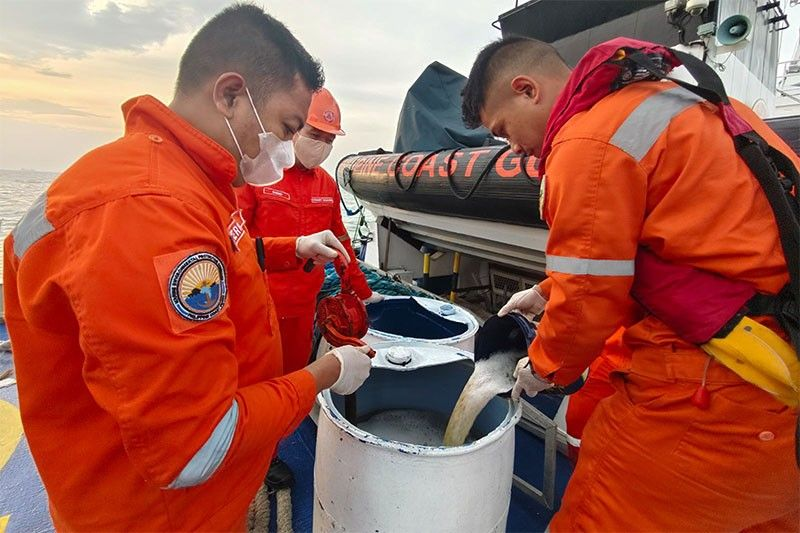
“It’s just small volume flowing out, tanks are intact, ”Philippine Coast Guard Spokesman Armand Balilo said oil slick from tanker Terra Nova sank off coast of Bataan has now reached coastline of Bulacan.
This was confirmed to President Ferdinand Marcos Jr.by Bulacan Gov. Daniel Fernando during situation briefing on effects of Typhoon Carina in the provinces of Bulacan, Pampanga and Bataan at session hall of Sangguniang Panlalawigan ng Bulacan in Malolos City.
Fernando said oil slick was sighted in the coastal area of Barangay Pamarawan in Malolos City as confirmed by its barangay chairman.
As this developed, Fernando sought assistance of the President to set up oil slick booms in coastal areas of Bulacan to protect its aquatic resources and fishpond industry of the province.
Environment Secretary Maria Antonia Yulo-Loyzaga agreed oil spill should be contained but noted commercial oil booms are too expensive and suggested that organic oil booms should be used because these are cheaper to make.
Loyzaga explained rice straws and coconut husks could be processed to come up with organic oil boom.
The President agreed to Loyzaga’s suggestion and proposed Tulong Panghanapbuhay sa ating Disadvantaged/Displaced Workers program of the Department of Labor and Employment be implemented to provide livelihood project for residents affected by floodwaters caused by Carina and southwest monsoon.
Top officials of Bulacan, Pampanga and Bataan were advised by Loyzaga to gather these indigenous materials and technical people will be sent to them to teach their respective residents how to make organic oil boom.
Science and Technology Secretary Renato Solidum and Health Secretary Ted Herbosa also suggested using “oil-eating bacteria” to help contain oil slick.
Solidum quoted oil pollution expert Hernando Bacosa, saying “Manila Bay has lot of oil-degrading bacteria because area is major shipping and transportation hub.”
The Chief Executive has also advised Department of Social Welfare and Development to be on standby for what assistance it can provide to residents that can be affected by oil slick.
Top officials of Bulacan, Pampanga and Bataan are also asking for advisory on early fish harvests on coastal fishponds in their provinces the President said should be done immediately.
Department of Environment and Natural Resources will conduct assessment of impacts of oil spill in Manila Bay together with University of the Philippines Marine Science Institute to assess extent and direction of oil spill, as well as its characteristics and content, according to DENR Assistant Secretary Noralene Uy.
President Marcos formed interagency task force that would immediately act on oil spill threatening to affect nearby provinces.
Some of 1.4 million liters of industrial fuel oil inside Terra Nova has started to leak into Manila Bay, coast guard said as they raced to avoid environmental catastrophe.
Tanker sank in bad weather off Bataan early Thursday, killing one crewmember and leaving the country potentially facing its worst oil spill disaster.
Oil slick has more than tripled in size and is now estimated to stretch 12-14 kilometers across bay, thousands of fishermen and tourism operators rely on for their livelihoods.
Divers inspected hull of the vessel and saw “minimal leak” from valves, Balilo said, adding it was “not alarming yet.”
“We’re hoping that tomorrow we will be able to start siphoning oil from motor tanker,” he said.
Ship that will carry recovered oil is on its way to the area, he said.
Coast guard has warned if entire cargo leaked would be “environmental catastrophe.”
It has previously said oil leaking from tanker appeared to be diesel fuel used to power the vessel, resting on the sea floor under 34 meters (116 feet) of water.
Coast guard now thinks slick is mixture of diesel and industrial fuel oil.
Oil containment booms have been deployed for what Balilo earlier described as “ worst case scenario” of cargo leaking out.
Three coast guard vessels were also spreading dispersants on oil.
Balilo called for suspension of fishing in Manila Bay to prevent people “eating contaminated fish.”
Vessel sank nearly seven kilometers from its origin in the port of Limay west of Manila. It was attempting to return to port after running into bad weather.
Sixteen of the 17 crewmembers were rescued from tanker, vessel tracking website vesselfinder.com said was 65-meters long and built in 2002.
Incident occurred as heavy rains fuelled by Typhoon Carina and seasonal monsoon lashed Manila and surrounding regions in recent days.
State weather service said monsoon had weakened by late Friday, giving authorities window of relative calm at sea to recover cargo.
Coast guard estimates extraction would take at least seven days.
It met with representatives of MT Terra Nova’s owner and contracted salvage company on Friday to discuss timeline.
Efforts to drain oil from Terra Nova are expected to start today as experts have observed apparently wider extent of oil spill, according to Philippine Coast Guard.
Philippines has struggled to contain serious oil spills in the past.
It took months to clean up after tanker carrying 800,000 liters of industrial fuel oil sank off central island of Mindoro last year, contaminating waters and beaches of island and devastating fishing and tourism industries.
Another tanker sank off central island of Guimaras in 2006, spilling tens of thousands of gallons of oil destroyed marine reserve, ruined local fishing grounds and covered stretches of coastline in black sludge.

 ISKUP!