
iskup news-on-line daily
7 Marso 2024, Huwebes
supports Fire Prevention Month
deepest sympathy to family of the late Danilo Halili
supports Women Month March
joins Christian nations in observance of Lenten season
SCS must be sea of peace
By Nidz Godino
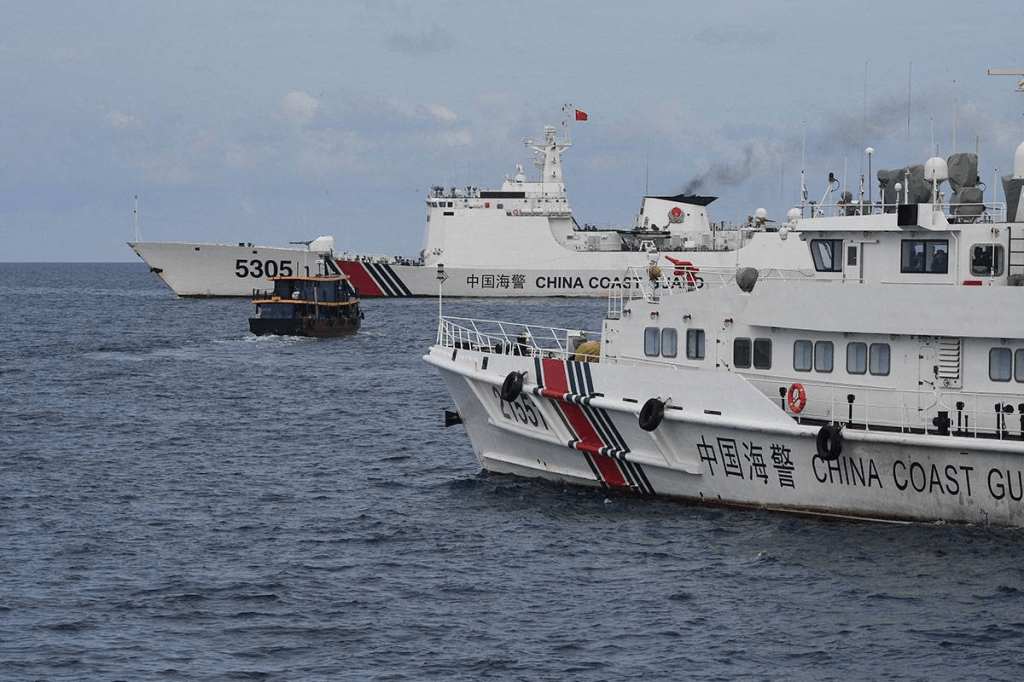
“We encourage all countries to avoid any unilateral actions that endanger peace, security and stability in the region,” joint declaration hammered out between 10-nation Association of Southeast Asian Nations (ASEAN).members and Australia warned against actions “endanger peace” in South China Sea, following fresh maritime confrontations between China and Philippines.
Simmering tensions in trade corridor threatened to boil over earlier this week, when China Coast Guard (CCG) ships in Spratly Islands were accused of hounding Philippine Coast Guard (PCG) vessels.
China claims almost entirety of South China Sea, ignoring legal precedents and competing claims from host of Southeast Asian nations.
Festering dispute poses one of the region’s most vexing security challenges, looming large during three-day summit between Australia and ASEAN.
“We recognize benefits of having South China Sea as sea of peace, stability and prosperity,” statement said.
As summit kicked off on Monday morning, Foreign Affairs Secretary Enrique Manalo delivered simple message to Beijing: “Stop harassing us.”
The following day, CCG boats were accused of harassing flotilla of Philippine ships sailing on resupply mission.
Chinese vessels were involved in two separate collisions, PCG said, and blasted one of resupply boats with powerful water cannon.
Bound to act by consensus, ASEAN forum has long struggled to make inroads on overlapping claims staked throughout South China Sea.
But fraught atmosphere hanging over region has nations such as Philippines now pushing for bloc to take firmer stance.
Close United States ally Australia has proven increasingly willing to speak out against China.
“We need to make sure that activity in South China Sea alleviates any tensions and doesn’t add to it,” Australian Prime Minister Anthony Albanese told reporters at the summit
Emphasizing the need to understand lessons of history, President Ferdinand Marcos Jr. called on members of ASEAN, Australia and other like-minded states to remain committed to rules-based international order amid actions “denigrate, deny and even violate international law.”
In his intervention during ASEAN-Australia Special Summit Leaders’ Retreat in Melbourne, FMJ argued rules-based international order “emanates from lessons of history.”
According to Marcos, conflicts and war “necessitated international order based on institutions and rules of universal import.”
“We need not repeat history in order to recognize its lessons,” Marcos said.
Without mentioning China, the President reiterated Philippines would not yield even inch of its sovereign territory and is committed to defending its rights within parameters recognized by international law.
According to Marcos, it remains responsibility of each state “to promote and protect rule of international law as much as any other state facing wanton military might.”
“We acknowledge ASEAN’s oldest dialogue partner’s support not only through statements, but also through concrete initiatives recognize Philippines’ rights under international law in South China Sea,” Marcos said, referring to Australia.
“ Philippines’ hope ASEAN continues to collectively and constructively address challenges together.”
The President also expressed suspicion on recent presence of Chinese research vessels in Philippine Rise (formerly known as Benham Rise), describing it as “clear intrusion” into Philippines’ maritime territory.
“Once again, this is clear intrusion into our Philippine maritime territory and it is, as usual, of great concern…and I see this as absolutely unnecessary because if it is truly research vessel then we could have come to very simple agreement that research vessel will ply waters and do the research they need to do.however, there is suspicion that they are not only research vessels so, again, this is bit of escalation of tension present in West Philippines Sea ,” the President said.
Earlier this week, American maritime expert Ray Powell said two Chinese research ships were spotted in northeast corner of Philippine Rise, 13-million hectare submerged continental shelf off Aurora province.
According to Powell, Chinese ships Haiyang Dizhi Liuhao and Haiyang Dizhi Shihao left Guangzhou last Feb. 26 and moved east southeast through Luzon Strait.
Last Monday, the Philippine Navy reported that Chinese research ships are already out of the Philippines’ exclusive economic zone.
In same video message, Marcos said decision on whether to increase frequency of joint military exercises with Australia hinges on situation in West Philippine Sea.
After China Coast Guard vessels 21555 and 21551 fired their water cannons and broke windshield of resupply boat Unaizah May 4 at 8:15 in the morning of March 5, another CCG vessel dispatched rigid-hull inflatable boat and circled damaged boat, Philippine Coast Guard-West Philippine Sea spokesman Commodore Jay Tarriela disclosed during National Security Council press conference.
“As result of water cannoning, PCG’s Multi-Role Response Vessel 4407 or BRP Sindangan ,MRRV 4407 received radio call from Unaizah May 4 that four of its crew have been injured,” Tarriela said.
This prompted PCG’s BRP Sindangan to dispatch RHIB and provide medical assistance to injured personnel.
“Despite damage Unaizah May 4 sustained because of water cannon and near collision, they know for a fact that Unaizah May 4 had injured personnel onboard… CCG 21551 launched RHIB and circled around Unaizah May 4 trying to document, as if we are ones doing illegal activities in our EEZ, exclusive economic zone,” Tarriela added.
Chinese Maritime Militia (CMM) reportedly continued to shadow Unaizah May 4 and BRP Sindangan even as they already began their travel back to Palawan.
As to slight collision incident involving BRP Sindangan with CCG vessel, Tarriela said it has reportedly been practice of Chinese vessels “they would block our pathway, they are going to stop all their engines and they would appear that they would stay there so that there would be possibility for Philippine Coast Guard vessel to collide with their vessel.”
He also questioned sincerity of CCG in preventing collision because while PCG personnel made effort to lessen impact, CCG personnel were seen taking videos of incident.
Defense Secretary Gilberto Teodoro Jr. described China’s behavior in West Philippine Sea as “downright uncivilized” following Tuesday’s collisions and water cannon attacks damaged ships and injured four Navy personnel.
“Acts of PRC’s agents in West Philippine Sea are patently illegal and downright uncivilized,” Teodoro said in statement as he urged China to “be truthful and to be believable… propaganda mechanisms of PRC once again attempt to justify their illegal acts against Philippine vessels on their so-called ‘indisputable’ claim over most of the South China Sea,“Teodoro said.
According to Teodoro, China is taking “great pains to mischaracterize their provocations as lawful under international law,” similar to how PRC asserts that actions of CCG and its maritime militia vessels are “professional, restrained, reasonable and lawful.”
Armed Forces of the Philippines Western Command commander Vice Admiral Alberto Carlos was among those slightly hurt when Chinese coast guard vessels pounded civilian supply boat Unaizah May 4 with water cannons on Tuesday while on rotation and resupply (RORE) mission to Ayungin Shoal.
Carlos said force of water cannon attacks shattered windshield of civilian supply boat carrying him and other Philippine Navy personnel, resulting in minor injuries.
Despite what happened, Carlos said directive of President Marcos is “we will not yield, we will not, we will be undeterred and we will not leave Ayungin” and RORE missions will continue with operations adjusted accordingly to ensure success and safety of personnel.
Following latest collision and water canon attacks on PCG ships by CCG vessels, National Task Force on West Philippine Sea accused China of being one that is actually stirring up trouble that has now resulted in people getting hurt.
“It is China that is deliberately stirring up trouble and maliciously inciting hype and not Philippines…we wish to remind China that when it points finger at others, there are three other fingers pointing back at them, China’s latest unprovoked acts of coercion and dangerous maneuvers against legitimate and routine rotation and resupply mission to Ayungin Shoal in WPS have put lives of our people at risk and caused actual injury to Filipinos on board supply ship,” National Security Council assistant director general Jonathan Malaya said.

 ISKUP!